The Complete Guide to Body Jewellery

Most piercing problems are jewellery problems. Not aftercare, not technique, not bad luck. The wrong metal, the wrong length, the wrong threading or the wrong shape, sitting in a piercing for months and quietly causing trouble.
Get the jewellery right and most piercings behave. This covers everything that decides that.
Materials, Which Matter Most
Implant-grade titanium. The standard for anything fresh, and an excellent long term choice. No nickel, exceptionally biocompatible, light, does not corrode. Can be anodized into colours, where the colour comes from an oxide layer on the metal itself rather than a coating that wears through. Inexpensive. There is no situation in which it is the wrong choice for a new piercing.
Surgical steel. Not a regulated term, which is the crucial point. It sounds precise and it ranges from properly certified implant grade material to whatever a manufacturer chooses to call it. Almost all stainless steel contains nickel. In good steel it is bound tightly and little escapes. In cheap steel it leaches, and nickel sensitivity is one of the most common contact allergies there is. Fine in a healed piercing on somebody who tolerates it. Not the choice for anything fresh.
Solid gold. 14 or 18 carat is the range for body jewellery. Pure gold is too soft to hold a thread. What matters is what it is alloyed with. White gold is frequently alloyed with nickel and rose gold gets its colour from copper, so yellow gold is generally the safest. Beautiful in a healed piercing and an investment that lasts decades.
Gold plated. A thin layer of gold over another metal. It wears through, particularly on anything that moves in a piercing, and what is underneath is usually exactly the material you were avoiding. No place in a fresh piercing and limited place in a healed one.
Niobium. Similar to titanium in biocompatibility, heavier, and can also be anodized. A perfectly good alternative and less commonly stocked.
Glass. Used mainly in stretched lobes. Inert and comfortable, though breakable.
Organic materials. Wood, bone, stone and horn. For fully healed, stretched piercings only. Porous, cannot be sterilized properly, and should never go anywhere near a fresh piercing.
Acrylic and plastic. Cheap, degrades, cannot be autoclaved, and scratches easily, and scratches harbour bacteria. Retainers made for the purpose are a specific exception.
If you are nickel sensitive, and a great many people are without knowing, the only safe answers are implant-grade titanium and solid yellow gold.
Threading, Which Nobody Explains and Everybody Should Know
This decides comfort more than any other single feature.
Externally threaded. The screw thread is cut into the post, so the threaded section passes through your tissue every time the jewellery goes in or out. It drags across the inside of the channel, which is uncomfortable at best and damaging at worst. It is also the cheapest way to manufacture jewellery, which is why almost all low quality pieces are made this way.
Internally threaded. The post is smooth and the thread is inside it, with the decorative end carrying a small male thread that screws in. Nothing rough passes through the piercing.
Threadless, sometimes called press fit. The end has a small bent pin that pushes into a hollow post and holds by tension. No threads at all. The most comfortable to wear and the easiest to change once you have the knack, which is a small bend and a firm push rather than a screw.
What to take from this. Internally threaded or threadless for anything going into a piercing you care about. External threading is a reliable marker of cheap manufacture, so it tells you about the metal as well as the comfort.
Sizing, in Two Numbers
Every piece of body jewellery has two measurements and getting either wrong causes problems.
Gauge is the thickness. Confusingly, a larger gauge number means thinner jewellery. Most ear and facial piercings sit around one range, navels and some others are typically thicker.
Thickness matters because thin jewellery concentrates pressure into a narrow line of tissue, and tissue under concentrated pressure gives way. That is the mechanism behind a good proportion of migrations. Going thinner to fit a piece you like is one of the more common self inflicted problems in piercing.
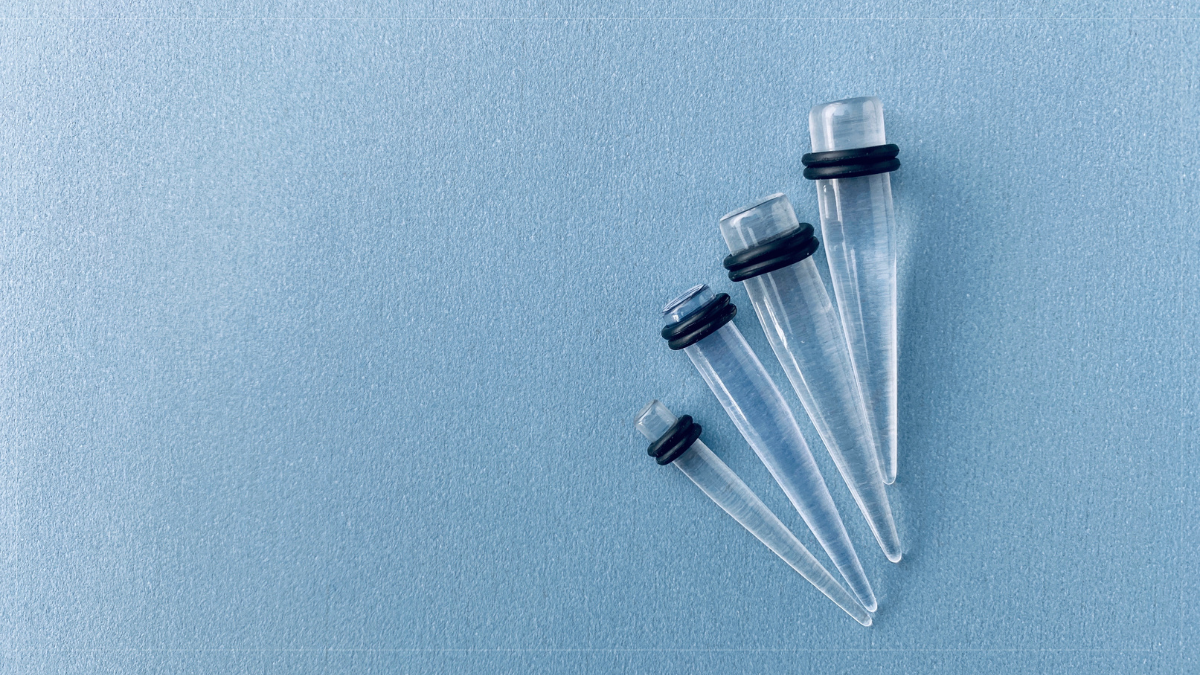
Going thicker means stretching, which is a deliberate gradual process with proper tapers, never something to achieve by forcing a larger post through.
Length or diameter is the size. For a bar, the length of the post between the ends. For a ring, the internal diameter.
Too long and it catches on everything, which is the leading mechanical cause of irritation bumps. Too short and it presses on both openings, which is worse and can cause the jewellery to embed.
Fresh piercings are deliberately fitted long to allow for swelling. That is why a new piercing looks like it has too much bar showing. It is not a mistake and it is why the downsize matters.
The Downsize, Which is the Most Skipped Appointment in Piercing
Once swelling has gone, usually somewhere between four and eight weeks, the long bar that protected your piercing becomes the thing causing it harm.
A bar with excess length is a lever. Every time it catches on a jumper, a towel, a hairbrush or a pillow, that leverage transmits into the healing channel and drags it sideways. Repeated over months it produces irritation bumps, uneven healing and migration.
Downsizing takes a couple of minutes, usually costs only the price of the smaller bar, and prevents more problems than any other single intervention.
Book it when you get pierced rather than waiting to remember.
Why Jewellery Causes More Problems Than Technique
Worth understanding, because it reframes how you think about a piercing that is not behaving.
A piercing is a small wound that your body is trying to convert into a lined channel. Doing that takes months, and throughout those months there is a piece of metal sitting inside the wound, in continuous contact with the tissue doing the work.
Nothing else in medicine or cosmetics asks tissue to heal around a permanent foreign object at the same time. That is genuinely unusual, and it means the object itself is not a detail. It is the single most influential thing in the environment.
So when a piercing will not settle, the useful questions are almost always about the jewellery rather than about hygiene. Is the metal releasing something the tissue is reacting to. Is there excess length acting as a lever. Is the gauge thin enough to concentrate pressure. Is the shape fighting the anatomy. Is a screw thread dragging through the channel at every change.
Cleaning harder addresses none of those, and over cleaning adds irritation of its own. This is why a piercer looking at a troubled piercing will reach for a different bar rather than a different cleaning routine, and why so many stubborn problems resolve within a fortnight of a jewellery change.
Anodizing, plating and coating, which are three different things
These get used interchangeably and they are not the same, which matters when you are spending money.
Anodizing passes an electrical current through titanium or niobium, thickening the oxide layer that already exists on its surface. The colour comes from light interference within that layer rather than from any added material. Nothing is deposited, nothing can flake off, and the metal underneath is unchanged. This is why anodized titanium is safe in a fresh piercing and why the colour cannot wear through to something else. It can fade or shift over years, particularly with abrasion, and if it does the metal beneath is the same titanium you started with.
Plating deposits a thin layer of one metal onto another, most often gold over steel or brass. It is measured in microns and it wears, particularly on any surface that moves against tissue or clothing. When it wears, the base metal is exposed against your skin.
PVD coating is a harder, more durable surface treatment than traditional plating and holds up considerably better. It is still a coating, and a coating on an unknown base metal is still an unknown base metal.
The practical rule is simple. Colour that comes from the metal itself is safe. Colour that comes from something added is only as good as what it is hiding, and it will not last forever.
Stretching, Briefly and Properly
Not everybody wants stretched lobes and the people who do frequently get bad advice, so it is worth the paragraph.
Go slowly. One size at a time, with weeks or months between, and never skip a size. The single most common cause of permanent damage is impatience.
Never force anything. If a taper will not go through comfortably, the tissue is not ready. Forcing tears it, and torn tissue heals as scar, which stretches badly and thins.
Use proper tapers, not tape and not jewellery. Wrapping tape around a plug to increase its size gradually is a widely shared method and it is a poor one, because it is uneven and porous.
Massage and moisturize. Healthy, supple tissue stretches. Dry, tight tissue tears.
Know that there is a point of no return. Lobes stretched beyond a certain size will not shrink back, and reversing them is a surgical matter. Where that point sits varies between people, and it is worth asking before you pass it rather than after.
Materials change at larger sizes. Once healed and stable, glass, stone and properly finished wood become options. None of those belong in a lobe that is still recovering from a stretch.
The Main Styles and What Each is For
Flat backed labret stud. A straight post with a flat disc on one side and a decorative end on the other. The most useful and most comfortable piece in body jewellery. Suits lobes, helix, conch, flat, tragus, nostril and more. The flat disc sits close, catches on nothing and is the most comfortable thing to sleep on.
Barbell, straight. A post with a ball or end at each side. Industrials, some ear projects, tongues.
Barbell, curved. A gently curved post. Navels, rooks, daiths, eyebrows. The curve follows the anatomy so the jewellery is not fighting the shape.
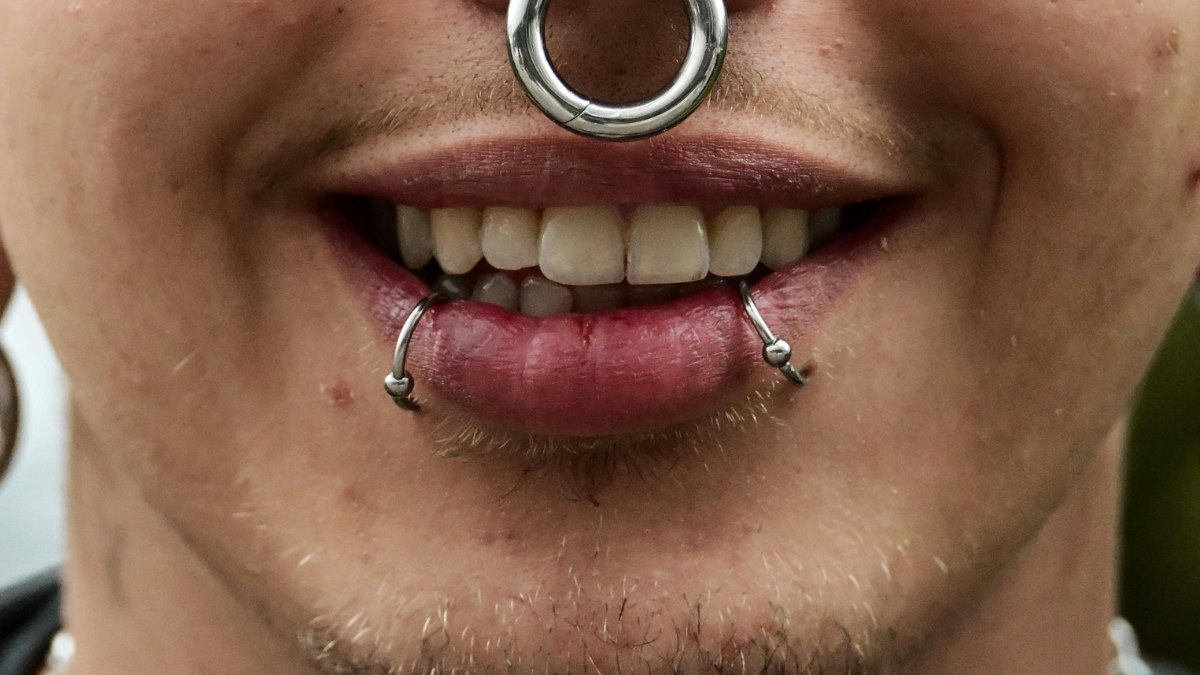
Circular barbell or horseshoe. An open ring with two ends. Septums, some ear placements. Easy to clean, and a septum horseshoe can be flipped up out of sight.
Captive bead ring. A ring held closed by a bead under tension. Traditional, and fiddly to change.
Clicker. A segment ring with a hinged section that clicks shut. Far easier to handle than a captive bead ring and the most popular ring style now.
Seamless ring. A continuous ring with a small gap, bent open and closed. Cleanest look, needs a light touch, and repeated bending weakens the metal.
Retainer. Designed to hold a piercing open while being as close to invisible as possible. For workplaces and situations where jewellery has to be hidden.
When to Change Jewellery, and When Not To
Not until it is healed, and healed means considerably longer than comfortable. Lobes are six to eight weeks. Most cartilage is six to nine months. Navels can be a year.
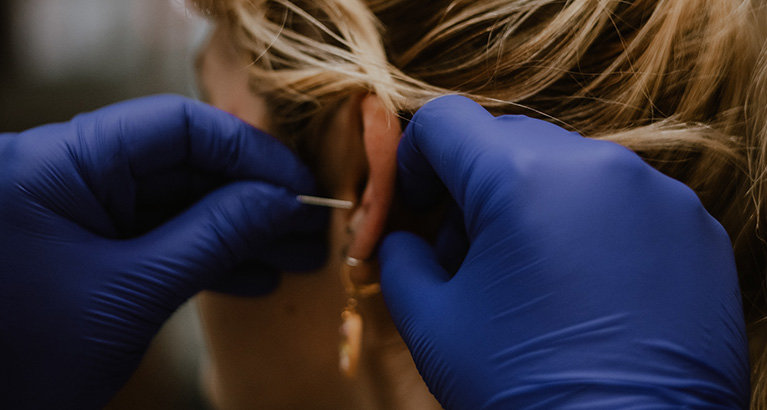
Have the first change done by a piercer. Every studio has stories of somebody removing jewellery at four months, failing to reinsert for twenty minutes and arriving with a partly closed channel. A piercer changes it in seconds and confirms the piercing is genuinely ready.
A settled piercing that is still occasionally tender is not ready for a ring, in particular. Rings move constantly and constant movement on immature tissue undoes progress.
Keep the gauge consistent. Going thinner lets the channel shrink and going thicker means stretching.
Clean new jewellery before it goes in, even from a reputable supplier.
If it will not go in easily, stop. Forcing anything through a piercing damages the channel. Come in and let somebody look.
Buying Jewellery Without Getting it Wrong
Ask what the material actually is, not what it is called. A studio buying properly can tell you the specification.
Avoid anything described only as surgical steel with no grade attached.
Avoid external threading.
Avoid plated anything if it will be worn in a piercing that moves.
Be suspicious of very low prices. Properly made titanium jewellery is not expensive, and anything dramatically cheaper has been made from something cheaper.
Buy the size, not the picture. A ring that looks perfect on somebody else is a specific diameter on a specific anatomy. Get sized in person.
One good piece beats five poor ones. An ear with one lovely statement piece and plain titanium elsewhere reads far better than an ear full of mediocre jewellery.
Buying Online Without Ruining a Piercing
Most people buy jewellery online at some point and there is a right way to do it.
Get sized in person first. You need three numbers before you buy anything: the gauge, the length or diameter, and for a labret the disc size. A piercer will give you all three in a minute. Buying without them is guessing, and the guess is usually wrong in the direction that causes problems.
Buy from suppliers who publish material specifications. A listing that says implant grade and names the standard is telling you something. A listing that says titanium, or surgical steel, or hypoallergenic, with nothing further, is telling you the seller either does not know or would rather not say.
Read the threading. If it is not stated, assume external, because internal and threadless are selling points that get mentioned.
Beware of listings that describe the look rather than the object. Long descriptions of sparkle and finish with no measurements or materials are marketing rather than specification.
Expect to pay properly. Well made titanium is not expensive and it is not nearly free either. Anything dramatically below the range is made from something else.
Do not buy for a piercing that is not healed. No exceptions, however careful the seller looks.
Keep the packaging until you have worn it. If a piece turns out to be the wrong size, which happens, you want to be able to return it rather than trying to make it work.
What to Do When Jewellery Gets Stuck, Lost or Broken
The small emergencies, and what actually helps.
A ball that will not unscrew. Usually seized rather than jammed. Dry hands, a piece of clean rubber glove for grip, and gentle pressure. Do not use pliers on jewellery in a piercing. If it will not move, come in.
A threadless end that keeps falling out. The pin needs a slightly greater bend to hold. A piercer does this in seconds and it is a very common issue rather than a fault.
Jewellery lost overnight. The channel starts shrinking within hours on a newer piercing. Put anything clean and correctly sized in temporarily rather than leaving it empty, and come in as soon as you can. A retainer kept in a drawer is genuinely useful for exactly this.
A broken bar or a cracked stone. Stop wearing it. A rough edge inside a piercing causes real damage quickly.
Something embedded, where the jewellery has sunk below the surface. This is not a wait and see. Come in the same day if possible, because embedded jewellery worsens and can require more than a simple change to resolve.
A piercing that will not accept jewellery back in. Do not force it. Forcing creates a false channel alongside the real one, which is painful and heals badly.
Caring for jewellery
Wash it when you take it out, with warm water and a little unscented soap, and dry it properly.
Titanium and solid gold need essentially nothing. Steel may tarnish over time. Plated pieces will lose their surface and there is no maintenance that prevents it.
Store pieces separately rather than loose in a dish, where they scratch each other. Scratches on jewellery worn in a piercing hold bacteria.
Check threads occasionally. A loose end is how jewellery gets lost, and threadless pieces need the pin bend checked so they hold firmly.
Building a collection worth having
Jewellery is the part of piercing that lasts longest and gets the least thought, so it is worth being deliberate.
Start plain. Every fresh piercing wears simple implant-grade titanium while it heals, whatever the eventual plan. That is not a compromise, it is the procedure.
Buy one good piece at a time. As each piercing settles, choose something you genuinely like rather than filling every position at once. Spread over a year or two this is very manageable and it means the collection reflects your taste as it develops rather than a single afternoon's decisions.
Have a plain set and a dressed set. Most people end up with simple titanium for work, sport and sleeping, and better pieces for occasions. Being able to swap without thinking is worth more than owning one expensive piece you never take out.
Keep a spare of anything critical. If you have a piercing that closes quickly, keep a plain replacement somewhere you can find it at midnight.
Retainers earn their place. Even if you never expect to need one, a job, an operation, a sport or a school rule can arrive without notice, and a retainer means a piercing survives it.
Repeat a material or a motif if you wear several pieces together. Coherence across an ear or a face does more for how it reads than the individual pieces do.
Resist the urge to own everything. A small number of well made pieces, correctly sized and comfortable, beats a drawer of things that nearly fit.
What We Stock and Why
Our jewellery is implant-grade titanium as standard for anything going into a fresh piercing, in a range of ends and colours achieved by anodizing rather than by plating, so the colour is the metal itself and nothing can wear through to something underneath.
Beyond that we carry solid gold for healed piercings, and pieces from makers whose material specifications we can actually state rather than guess at.
We do not stock externally threaded jewellery, because there is no version of it that is good for a piercing. We do not stock plated pieces for anything that moves in a piercing, for the same reason.
If you want something we do not have, tell us and we will tell you honestly whether it is a good idea and, if it is, where the properly made version of it comes from. We would rather point you elsewhere for a piece that suits you than sell you something that will not.
Come in and be sized properly. Nearly every jewellery problem we see began with somebody guessing at a measurement.
Jewellery for Specific Placements, at a Glance
The right shape for each site, since this is the question people arrive with.
Lobes. Flat backed labret studs for comfort, particularly if you sleep on your side. Rings and clickers once healed. Almost anything is tolerated here.
Helix and flat. Flat backed labret to heal. Rings, clickers and decorative ends once settled. Diameter matters for rings because the rim curve varies.
Forward helix. Small flat backed studs. The space is tight and larger ends press against the head.
Conch, inner. Flat backed labret, always. The disc sits behind the ear and catches on very little.
Conch, outer. Flat backed labret to heal, then a ring sized to travel around the rim comfortably.
Tragus. Small flat backed labret. Ends that project too far catch on earbuds and phone screens.
Daith. Curved barbell to heal, clicker once settled. Diameter has to suit the fold.
Rook. Curved barbell. The curve follows the ridge rather than fighting it.
Industrial. A straight barbell, fitted long at first, downsized once swelling settles. Decorative centre bars only when fully healed.
Septum. Circular barbell or horseshoe to heal, which also flips up out of sight. Clicker once settled. Pierced at a slightly thicker gauge than ear work for good reason.
Nostril. Flat backed labret to heal, always. Ring at four to six months. Avoid nose bones and screws entirely.
Navel. Curved barbell, which follows the anatomy. Fitted long for swelling and downsized after.
Eyebrow. Curved barbell.
Dermal. Anchor with a low profile top while healing. Taller and more decorative tops only once settled, since anything that projects catches.
If a piece of jewellery you like does not come in the shape a placement needs, the placement wins. A ring in a site that wants a bar will cause trouble however good it looks.
Bottom Line
Implant-grade titanium in anything fresh, always. Internally threaded or threadless, never externally threaded. Fitted long at first for swelling, then downsized once it settles, which is the appointment most people skip and the one that prevents the most trouble.
Keep the gauge consistent. Have the first change done by a piercer. Do not force anything, ever.
Once healed, choose on preference. Good steel if you tolerate it, solid yellow gold if you want something with presence, titanium if you want the most comfortable option indefinitely. Avoid plated pieces in anything that moves.
Come in and we will size you properly and show you what the difference between cheap and well made jewellery actually feels like in your hand.
FAQ
What is the safest metal for a new piercing?
Implant-grade titanium. No nickel, exceptionally biocompatible, light and inexpensive. There is no situation where it is the wrong choice for something fresh.
Is surgical steel safe?
Sometimes, and you usually cannot tell. The term is unregulated, most stainless steel contains nickel and cheaper grades release enough to keep a healing piercing irritated.
What does internally threaded mean?
The thread is inside the post so nothing rough passes through your tissue when the jewellery goes in or out. Externally threaded jewellery drags a screw thread through the channel, which is uncomfortable and damaging.
Why is my new jewellery so long?
To allow for swelling. Once that settles, come back for a downsize, because excess length acts as a lever and is the leading mechanical cause of irritation bumps.
When can I change my jewellery?
Once healed, which is six to eight weeks for lobes and six to nine months for most cartilage. Have the first change done by a piercer.
Can I wear gold in a fresh piercing?
Yes! We suggest using solid yellow gold at 14 carat or above.
What gauge should my jewellery be?
The same as the piercing. Going thinner lets the channel shrink, and going thicker means stretching, which is a gradual process rather than something to force.
Is expensive jewellery worth it?
Titanium is inexpensive and excellent, so the cheap option is already good. Where money is worth spending is solid gold!