Mountain Tattoos

Mountains are among the most requested minimal designs and among the most commonly done badly, for a reason that has nothing to do with the subject and everything to do with geometry: a mountain is mostly straight diagonal lines, and straight lines punish every flaw.
The Two Kinds
A real range. A specific skyline — somewhere you climbed, somewhere you are from, somewhere that means something. Recognisable to anyone who knows it.
A symbolic mountain. A stylized peak or three, standing for challenge, endurance, perspective, or simply the outdoors.
They are different tattoos. The first needs accuracy and usually width; the second needs a strong composition and can be smaller.
If it is a real range, bring a photograph taken from the angle you remember it. A range looks completely different from the north than the south, and getting that wrong is the sort of error only you will notice — forever.
The Straight Line Problem
A mountain’s defining feature is its ridgeline: long, straight-ish diagonals meeting at a peak.
Your eye knows exactly what a straight line should look like. Any wobble, any variation in weight, any drift shows immediately — in a way it never would on an organic shape like a rose or a wave.
Three Consequences.
Placement matters more than usual. A ridgeline across a joint or a fold will bend when you move. The inner forearm, the inner elbow and the back of the knee are all places where a mountain can end up looking crooked.
Line weight matters. A hairline diagonal shows every millimetre of ink spread. A slightly heavier line has room to soften without the shape distorting.
The artist matters. Clean straight linework is a genuine skill and not evenly distributed. Look at their healed work, specifically at anything with long straight lines in it.
Styles
Blackwork and silhouette. Solid black peaks, or negative space carving them out. The most durable option by a distance and often the most striking. A solid shape has nothing thin to lose.
Fine line. The most requested and the least durable — thin diagonals with nothing else in the design. It looks beautiful for a decade. Expect a refresh. See our fine line article.
Dotwork and stippling. Popular for shading slopes. Bear in mind dots merge as they spread, so it needs deliberate spacing rather than density.
Black and grey realism. A photographic range with tonal depth. Needs size and a realism artist.
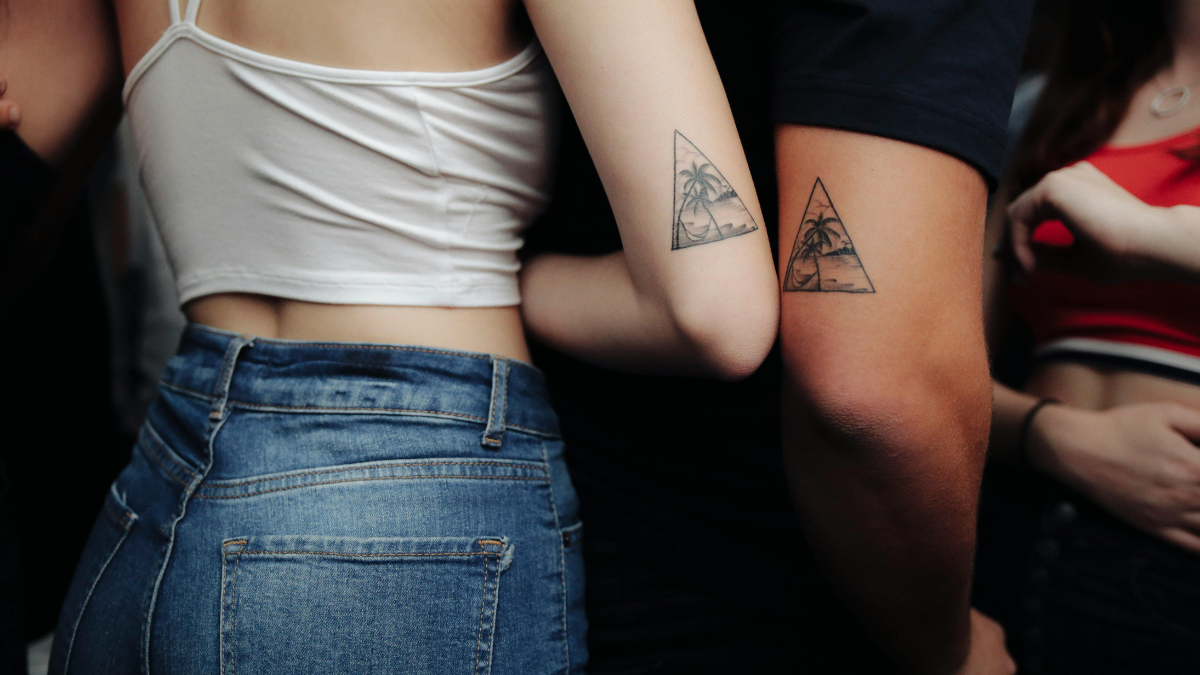
Geometric. A range contained inside a circle, a triangle or a frame. Very durable and currently very popular — and worth noting that the containing shape is itself a precision-line problem.
The Scene-Inside-a-Shape Thing
The mountain range inside a circle, with trees and sometimes a sun, is one of the most requested tattoos of the last decade.
It works.
Two cautions.
The circle is the hard part. A circle very slightly out of round reads as wrong the way a wobbly straight line does. Look at an artist’s healed circles.
Do not overfill it. A scene crammed with a range, a forest, a lake, a sun and a bird will, over fifteen years, become a dark disc. Fewer elements with more space between them still reads at forty years. This is the single most useful thing an artist can tell you about this design, and it usually sounds like them taking things out.
Size and Placement
Mountains are wide rather than tall, which is unusual and narrows the good placements.
Outer forearm, running across rather than along — the most common and one of the best.
Chest, across the collarbone line, which suits a wide range well.
Upper back and shoulder blade, plenty of width.
Calf for a taller composition.
Inner arm looks good and moves more than people expect.
Ribs and side for a large scene, and it hurts.
Avoid a long ridgeline anywhere that folds.
At Perfect Image
Mountains come through all our studios. Look through the artist pages for clean linework, because on this subject the lines are the whole piece.
If it is a real range, bring a photograph from the right angle. If it is a scene in a circle, let us stencil it and look at it properly on your skin before we start — that ten minutes is what stops a crooked horizon.
Bottom Line
Decide whether it is a real range or a symbol, because they need different things. Straight diagonals punish movement and thin lines, so choose a flat placement and a little more line weight than the reference. Blackwork silhouettes last longest, and if it is a scene in a circle, put fewer things in it than you want to.
FAQ
Which style lasts longest?
Blackwork silhouette. Fine line is the least durable.
Where is the best placement?
Somewhere flat and wide — outer forearm across the arm, chest, upper back.
Can I get a real mountain range?
Yes — bring a photograph from the angle you remember.
Do mountain-in-a-circle tattoos age well?
If they are not overfilled. Fewer elements, more space.
How small can one be?
Small works as a simple silhouette. Detailed scenes need size.
Do they hurt?
Placement decides it, not the design.