Neo-Traditional Tattoos, and What Makes Them Different

Neo-traditional keeps the bones of old school tattooing, which is a strong outline and a design built to stay readable, and then does something old school never did with the inside of it. Richer colour, real depth in the shading, more detail, and subjects drawn with the freedom of an illustrator rather than the constraints of a flash sheet.
That is the whole distinction. Traditional decides what a tattoo must survive. Neo-traditional accepts those rules and then spends everything it has left on the drawing.
It is one of the most popular styles working today and it is the one people most often point at without knowing its name. If you have ever seen a tattoo of an animal or a woman's portrait that looked like an illustration from a beautifully printed book, heavy at the edges and soft in the middle, that was probably neo-traditional.
Where it Came From
American traditional was built in an era of limited pigments and limited technology. Heavy black outlines, a small palette, and simple bold shapes were not a stylistic preference so much as the only things that reliably held up in skin over decades. The style is a set of engineering decisions that turned into an aesthetic.
Neo-traditional emerged when the tools improved. Better pigments, better machines and better needle configurations meant an artist could put far more information into the same square inch without it collapsing over time.
What is interesting is what neo-traditional chose to keep. It could have abandoned the heavy outline entirely, and plenty of other styles did. Instead it kept the structure, because the structure is what makes a tattoo still legible at twenty years, and used the new freedom on everything inside it.
Our comparison of fine line and bold traditional gets into that trade-off directly, since fine line made the opposite choice.
What it Looks Like, Specifically
Four things characterize the style, and knowing them makes it easy to identify.
A bold outline, but a varied one. Traditional uses a consistent heavy line all the way round. Neo-traditional varies line weight deliberately, going heavier where a form turns away from you and lighter where it catches light. That single change is what creates the sense of depth.
A much wider palette, used with restraint. Traditional works with a handful of colours. Neo-traditional uses many, including blended transitions between them, and the good work still limits itself to a coherent scheme rather than using everything available.
Genuine dimensional shading. This is the biggest departure. Traditional shading is largely flat, using solid black to define shape. Neo-traditional models form, so a flower has a lit side and a shaded side and reads as a three dimensional object.
Decorative framing. Ornamental elements around the subject, jewellery, filigree, gems, drapery, botanical borders. It is one of the style's most recognizable habits and it is what gives neo-traditional pieces their slightly ornate, illustrated quality.
The Subjects It Does Best
The style has a natural repertoire, and it is worth knowing because the fit between subject and style matters more than people expect.
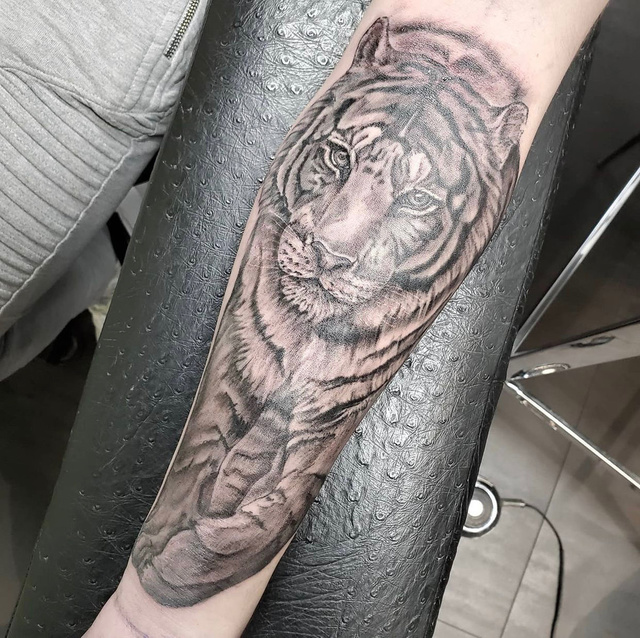
Animals, above everything. Foxes, owls, wolves, snakes, big cats, birds. The combination of a strong outline holding the silhouette with soft shading describing fur or feathers is exactly what the style is built for.
Portraits of a stylized rather than photographic kind. Not realism, which is a different discipline entirely, but a face drawn with character and framed with ornament.
Botanical work. Flowers, leaves and branches, particularly with insects or birds worked into them.
Objects with an antique quality. Lanterns, keys, hourglasses, ships, daggers, playing cards, pocket watches, ornate mirrors. Anything that suits being drawn as though it had been engraved on a printing plate a century ago, which is very close to what the style is emulating.
What it does less naturally is anything requiring photographic accuracy, and anything that needs to be very small. The style depends on internal detail and shading, and both need room.
How it Ages, Which is the Practical Question
Well, and considerably better than most of what it competes with.
The reason is the outline. As skin softens over decades and all ink spreads slightly, a piece with a strong black structure keeps its shape long after the internal detail has quietened down. The outline is doing the same job it does in traditional work, which is holding the design together while everything inside it gets a little gentler.
Two honest caveats.
The internal detail does soften first. Fine internal linework and the most delicate shading transitions are the first things to go quiet. A twenty year old neo-traditional piece reads as a slightly simpler version of itself, which is a much better outcome than reading as a smudge.
The lightest colours behave as they do everywhere. Yellows, oranges and pale pastels fade faster than deep colours. A good artist builds the design so those are accents rather than load bearing, which our comparison of colour and black and grey goes through in detail.
The practical consequence is that neo-traditional is a genuinely good choice for somebody who wants detail and colour but is worried about how it will look in fifteen years. It is close to the best available compromise between the two.
Size, and The Mistake People Make
The most common problem with a neo-traditional request is that the design somebody wants is too small for the amount of information in it.
The style is built on internal detail and modelled shading. Both need space. Ink spreads slightly over decades, and detail packed too tightly eventually merges into a single tone, which means a small neo-traditional piece can lose exactly the thing that made it neo-traditional in the first place.
An artist telling you it needs to be larger is not upselling. They are describing what the style requires to still be itself in a decade. If you want something genuinely small, a simpler traditional design will serve you better and will age better too.
As a rough guide, a forearm, a thigh, an upper arm or a calf gives the style room to work. A wrist or an ankle usually does not, unless the design is simplified to suit.
What a piece costs you in time
More sessions than traditional work of the same size, and the reason is straightforward.
Traditional work is fast because it is designed to be. Bold lines and flat colour go in quickly. Neo-traditional adds modelled shading, colour blending and internal detail, and all three are slow.
Expect the drawing stage to take longer too. Neo-traditional is almost always custom, since the style is about the illustration rather than about picking from a sheet, and a good artist will want to know what the piece is for before they draw a line of it.
Our article on what a tattoo costs in Ontario covers how pricing works generally, and our comparison of one long session against several covers how a larger piece gets broken up.
Where it Sits Against the Styles Beside It
People frequently arrive with a reference and the wrong word for it, so here is the map.
Against American traditional. Same structural logic, far more information inside. If your reference has a heavy uniform outline, flat colour and a simple bold shape, that is traditional. If the outline varies in weight and the inside is modelled with light and shadow, that is neo-traditional.
Against illustrative. The two overlap heavily and the distinction is soft. Illustrative is a broader term for anything drawn like a drawing, and much of it has no strong outline at all. Neo-traditional is illustrative work that kept the traditional skeleton.
Against realism. Completely different disciplines. Realism aims at photographic accuracy and generally avoids outlines entirely, because real objects do not have black edges around them. Neo-traditional is stylized by design and the outline is the point.
Against blackwork. Blackwork is defined by its restriction to black. A neo-traditional piece done in black and grey is still neo-traditional, because the defining features are line weight variation, dimensional shading and ornamental framing rather than the palette.
Against new school. New school pushes further into exaggeration, cartoon proportion and very saturated colour. Neo-traditional stays grounded in realistic proportion even while stylizing.
The practical use of all this is at the consultation. Bringing a reference and saying "this, but I am not sure what it is called" is completely normal and a good artist will name it and tell you whether it suits your idea and your placement.
Finding the Right Artist for It
Neo-traditional is a specialty rather than something every artist does, and the tells are visible in a portfolio if you know what to look for.
Look at how they handle line weight. A neo-traditional artist varies it deliberately. An artist applying a uniform heavy line to a detailed subject is producing traditional work with extra detail rather than neo-traditional work.
Look at the shading transitions. Smooth, modelled gradients that describe a curved surface are the hard part of the style. Banding, where you can see the steps between tones, is where a developing artist shows.
Look for repetition of your subject. An artist with twenty animals in their portfolio will draw your fox well. An artist with two, among a great deal of other work, might. Our guide to choosing a tattoo artist goes through reading a portfolio properly.
Look at healed work. Neo-traditional photographs beautifully on the day. Fresh colour is at its absolute peak, the shading is crisp, and there is usually a film of ointment throwing a flattering shine over everything. The question that matters is what those soft shading transitions look like six months later once the skin has settled, and only healed photographs answer it. An artist who posts healed neo-traditional work is showing you the version you actually get, and in this style specifically that is a strong signal.
Planning One Properly
Two things are worth doing before the consultation and they make a large difference to what you walk out with.
Bring references for the feeling, not the picture. Three or four images that share a quality you like, rather than one image you want reproduced. An artist can work with "I like how heavy and ornate these all feel" far better than with a single photograph they are being asked to copy, and most will decline to copy another artist's finished tattoo anyway.
Decide what the ornament is doing. Neo-traditional almost always frames its subject with something, and that framing is where a piece becomes yours rather than generic. Botanical, geometric, jewelled, draped, architectural. Having an opinion on that gives the artist somewhere personal to take the design, and it is the question most clients have never considered.
Then let the placement inform the shape. A neo-traditional piece designed flat on paper and then applied to a curved limb often fights the body. Designed for the placement from the start, the ornamental framing can follow the muscle and the piece sits as though it grew there. This is one of the clearest differences between a good artist and an average one, and it costs nothing to ask for.
Bottom Line
Neo-traditional gives you the durability of a traditional tattoo with the detail and colour of an illustration, and that combination is the whole reason for its popularity.
Two things to accept when you choose it. It needs to be bigger than you probably first imagined, because the style is built on internal detail and detail needs room. And it takes more chair time than a simpler piece of the same size, because modelled shading and blended colour are slow.
Give it those two things and it is one of the best ageing styles available in colour, because the strong outline keeps holding the design together long after the fine detail has gone quiet.
If you have a subject in mind and are not sure whether it suits the style, bring it in. Half the time the answer is obvious to somebody who works in it daily, and it takes a minute to say.
FAQ
What is the difference between traditional and neo-traditional?
Traditional uses a consistent heavy outline, a small palette and flat shading. Neo-traditional keeps the strong outline but varies its weight, uses a much wider palette and shades to create real depth. Same structural logic, far more detail inside it.
Does neo-traditional age well?
Yes, better than most detailed colour styles, because the strong outline holds the design together as skin softens. The finest internal detail quietens first, so a twenty year old piece reads as a slightly simpler version of itself.
How big does it need to be?
Larger than most people first picture. The style depends on internal detail and modelled shading, and both need room. A forearm, thigh, upper arm or calf works well. A wrist usually needs the design simplified.
Is it more expensive than traditional?
Generally, because it takes more chair time. Modelled shading, colour blending and internal detail are all slower than bold lines and flat colour, and the drawing stage takes longer since it is almost always custom.
Can it be done in black and grey?
Yes, and it works well. You keep the varied line weight, the dimensional shading and the ornamental framing, and give up the colour. It ages even more reliably that way.
How many sessions will it take?
Depends entirely on size and complexity. A single forearm piece can often be done in one long sitting. Anything larger is usually spread across several, and the artist will map that out at the consultation.
Is it good for a cover-up?
Often yes. The style's strong outlines and areas of deep colour give an artist somewhere to place existing dark ink, and the decorative framing is useful for disguising an old shape. Our guide to cover-ups and rework covers what is realistic.
Do you have artists who work in this style?
Yes. Check the artist pages for anybody listing neo-traditional as a niche, and if you are unsure which of our artists suits your idea, send it to us and we will point you at the right person.