Nose Rings, Studs and Hoops, and When to Wear Which

A nostril piercing is a small hole in a curved piece of cartilage and skin, and it is one of the few piercings where the jewellery has genuinely different shapes rather than just different decoration. The shape you choose changes how well it stays in, how it heals, and whether you spend a year finding it on the bathroom floor.
Here is what each one is, and when it is the right answer.
The Studs
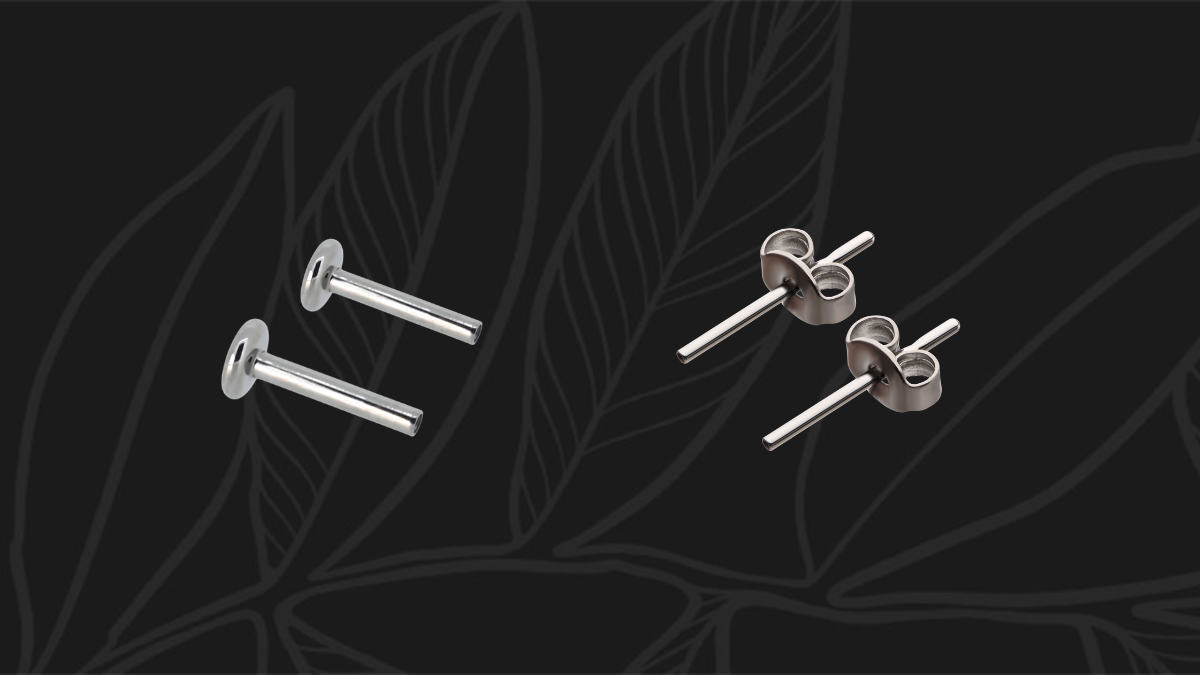
Flat back labret stud. A straight post with a flat disc on the inside of your nostril and a decorative front. This is what a careful studio will fit you with at the appointment and it is the best option by a distance while anything is healing. Nothing protrudes inside your nose, there is no hook to catch, and it does not rotate. The same piece of jewellery is used across most ear piercings, and we have written about why the flat disc changes so much.
L-bend. A straight post with a sharp ninety degree bend at the end, so it hooks inside the nostril. It goes in easily and it comes out easily, which is the whole problem. L-bends work loose, and an L-bend is the single most common piece of jewellery to be lost down a plughole.
Nose screw, sometimes called a corkscrew. A post with a curl at the end that follows the inside curve of your nostril. It holds better than an L-bend because the curl works against the tissue rather than simply resting behind it. Fitting one takes a twist of the wrist that feels wrong the first ten times. They are shaped for a particular side, so a screw made for a right nostril will fight you in a left one.
Bone, or a straight post with a ball end. A straight bar with a small bulge at the tip that is meant to sit behind the nostril. Getting it in means pushing that bulge through the channel, which is uncomfortable in a healed piercing and unacceptable in a healing one. We do not recommend them.
The Hoops
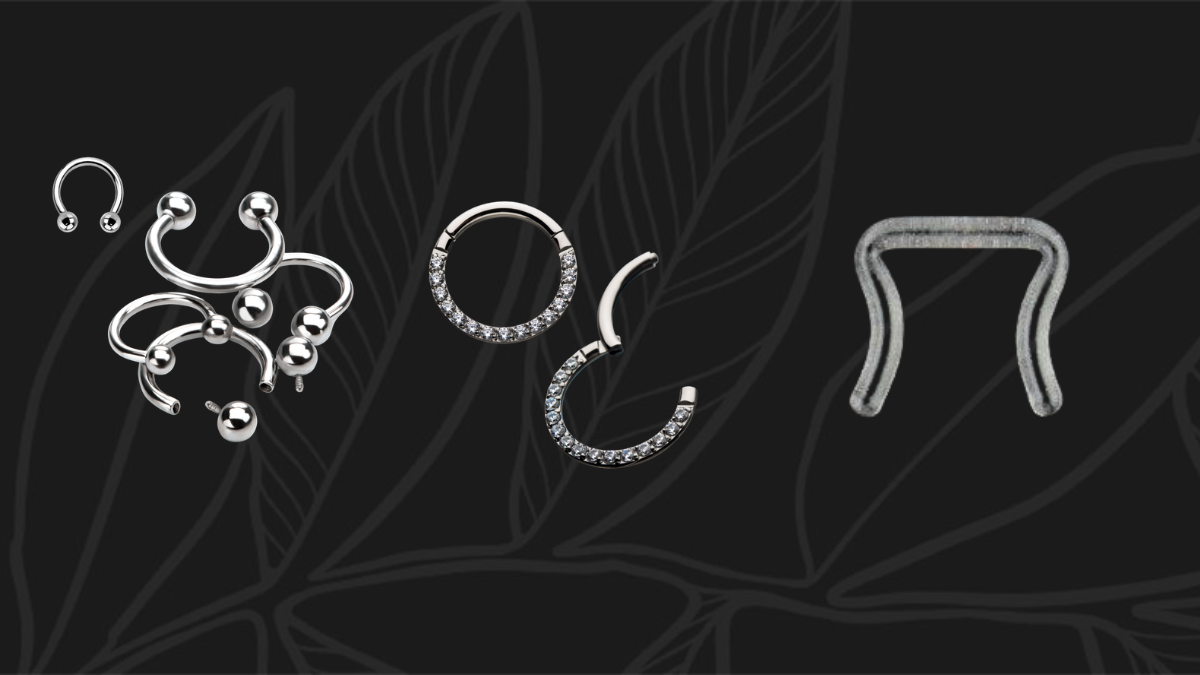
Seam ring. A plain circle with no visible join. You twist it open sideways and twist it closed. Beautiful and minimal, and it is easy to distort the shape by opening it the wrong way, which is by pulling the ends apart rather than twisting them past each other.
Captive bead ring. A circle with a small ball held in place by the tension of the ring. Secure once seated, fiddly to change, and the classic way to lose the bead is over a sink.
Clicker. A hinged ring with a segment that swings open and snaps shut. The easiest hoop to put in and take out by a wide margin, and the one we hand to most people who want a hoop. It costs more because there is a hinge in it.
When a Hoop is Actually Safe
Not while it is healing. That is the short version and it is worth the longer one.
A hoop moves. It rotates, it swings when you knock it, and every one of those movements drags the piercing channel against the jewellery. A healing channel is a fragile tube of new tissue and it does not survive being sawed at. A hoop is also awkward to clean around and gives crust somewhere to gather.
Most nostrils are ready for a hoop somewhere between four and six months, and some take longer. The test is not the calendar. It is whether the piercing has been completely quiet for several weeks, with no crusting, no tenderness when you touch it and no fluid.
If you want a hoop eventually, tell your piercer at the appointment. Placement for a piercing that will one day wear a ring is slightly different from placement for one that will always wear a stud, and it is much easier to get right at the start than to correct later. Our article on why piercings reject and migrate explains what happens when the angle is wrong.
Getting the Size Right
Three numbers, and getting any of them wrong is why jewellery does not fit.
Gauge, the thickness of the post or wire. Nostrils are usually pierced at 20g or 18g, and 18g is more common in studios doing careful work because a slightly thicker post holds its position better. Those two are not interchangeable. An 18g post will not go into a piercing made at 20g without force, and force is exactly what you should not apply.
Diameter, for hoops only. This is the width of the circle measured across the inside, and it is where almost everybody guesses wrong. Too small and it presses against the nostril, too large and it swings and catches. Common sizes sit between 6mm and 8mm, but the correct one depends on how far your piercing sits from the edge of your nostril and how thick that nostril is.
Post length, for studs. Same principle as anywhere else. Long enough to allow for swelling at first, then shortened once the swelling has gone. That second appointment is called downsizing, it takes minutes, and skipping it is why a stud starts to lean.
The honest advice is to have the first hoop fitted in person rather than ordered. Once you know your numbers you can buy confidently forever, and it is one visit to find out.
Material
For anything going into a healing piercing, implant-grade titanium with the standard actually printed. ASTM F136 is the one to look for. Our article on titanium, steel or gold covers why in full.
Solid gold is a genuine and lovely option in a healed nostril. Fourteen carat or higher. Yellow rather than white or rose, because white gold is alloyed with metals that a sensitive person may react to and rose gold gets its colour from copper.
Then there is everything gold coloured, and this is where nose jewellery listings become slippery, because a nostril stud is small and a photograph tells you nothing.
The distinction that matters is not gold against not-gold. It is what sits underneath the surface. A thin layer of gold applied over an unnamed base metal is a poor idea in a piercing that moves, because when the layer wears the base metal meets your tissue and you never knew what it was. A modern hard coating applied over a stated implant-grade substrate is a different product with a different lifespan, even though the listing photograph looks identical.
The question to ask a seller is simply what is underneath. It takes one message. A shop buying properly will answer it in a sentence, and a shop that cannot answer it has told you everything you needed to know.
Watch the phrase "14k gold" as well, which is used to mean solid fourteen carat and also, dishonestly, to describe the colour of a coating. If it does not say solid, ask.
Retainers, and When You Need One
A retainer is jewellery designed not to be seen. Usually clear glass or a plain titanium piece that sits flush, and it exists so that you can keep a piercing open in a situation where visible jewellery is a problem.
The obvious case is work, where some employers and most kitchens have rules. The less obvious ones matter more. Contact sports, where a hoop is a genuine hazard to you and to whoever you land on. Medical imaging, where metal has to come out and a glass retainer can often stay in. Any procedure where you are told to remove jewellery and you are worried the hole will close.
Glass is the material to ask for rather than plastic. Plastic retainers are porous, they scratch, and the scratches hold bacteria. Glass does none of that and it is not expensive.
A nostril closes faster than most people expect, sometimes within hours in the first year, which is the whole reason retainers exist.
Multiple Nostril Piercings
A second nostril piercing on the other side is straightforward and heals like the first. Two on the same side is a different conversation.
Spacing is the thing. Two piercings close together on one nostril share the tissue between them, and if that bridge of tissue is thin it will be under pressure from both sides. That is how a pair of piercings that were each fine alone start migrating together. A piercer will look at your nostril and tell you honestly whether there is room, and sometimes the answer is that there is room for a second but not in the position you had imagined.
If you already have one and are considering another, wait until the first is completely healed before adding to it. Healing two piercings at once in the same piece of tissue asks a lot of it.
The Septum is a Different Piercing
Worth saying plainly, because the jewellery is often sold on the same page. A septum piercing passes through the thin patch of soft tissue between your nostrils rather than through the nostril wall, it takes different sizes, and its jewellery is fitted differently. Clickers and circular barbells dominate there for reasons that are specific to that anatomy.
If that is what you are shopping for, our article on septum piercings is the right one, including the part most people want to know, which is how to wear one that nobody has to see.
When Your Piercing Won't Heal...
A nostril that has been sore for months is usually a hardware problem rather than a cleaning problem, and it is worth checking the jewellery before changing your routine.
A post that is too long lets the stud move every time you touch your face. A hoop worn too early drags the channel. A gauge that is too thin for the piercing lets tissue close in around it and pull it out of line. A bump sitting beside the piercing is very often the tissue objecting to being moved, not an infection.
The fix for all of those is a jewellery change, not a stronger cleaning product, and stronger cleaning products make most of them worse.
Changing Your Jewelry
Do it over a towel on a flat surface, never over a sink, and not in a hurry.
For a stud, hold the front and draw it straight out. For a screw, take the curl back out the way it went in rather than pulling.
For a seamless ring, twist the two ends past each other sideways. Pulling them apart bends the circle out of true and it never quite goes back.
For a clicker, press the segment until it releases, swing it open, and close it until you hear it. If it does not click, it is not closed.
Wash your hands first. Do not change anything in a piercing that is not fully healed, and if a piece is fighting you, stop and bring it in rather than forcing it.
At Perfect Image, we fit every nostril piercing with implant-grade titanium, we stock studs, clickers, seamless rings and captive beads, and we will size you rather than guess. We are also happy to change jewellery you bought elsewhere, and to tell you honestly whether it is something we would put in a piercing.
If you are somewhere between four and six months in and wondering whether you are ready for a hoop, come and let us look. It takes two minutes and it is free.
Bottom Line
Wear a flat back stud while it heals, because it does not move and it does not fall out. Move to a screw or a clicker once it is genuinely quiet, not once the calendar says so. Get the diameter fitted in person the first time. And when something is described only by its colour, ask what is underneath it.
FAQ
How long before I can wear a hoop?
Usually four to six months, sometimes longer. The test is several completely quiet weeks with no crusting, no tenderness and no fluid, not a date.
Why does my nose stud keep falling out?
Almost always an L-bend, which hooks rather than holds. A screw or a flat back stud solves it.
What size hoop do I need?
It depends on where your piercing sits and how thick your nostril is. Most people land between 6mm and 8mm, but have the first one fitted rather than ordered.
Is a nose ring the same as a nose stud?
No. A ring is a hoop that passes through and out again. A stud is a post with a decorative front. People use "nose ring" loosely to mean both, which is why listings are confusing.
My hoop will not close. What do I do?
Stop pushing. A distorted seamless ring or a stiff clicker hinge can both be fixed in studio in a minute, and forcing either is how they break.