
We collect basic website visitor information on this website and store it in cookies. We also utilize Google Analytics to track page view information to assist us in improving our website.
Ear piercing done with a needle, implant-grade titanium, and a piercer who will tell you honestly what suits your anatomy? Walk in at any of our six Ontario studios in Waterloo, London, Brantford, Barrie, and Grand Bend.
FIND YOUR NEAREST STUDIO
WHY CHOOSE PERFECT IMAGE FOR YOUR EAR PIERCING
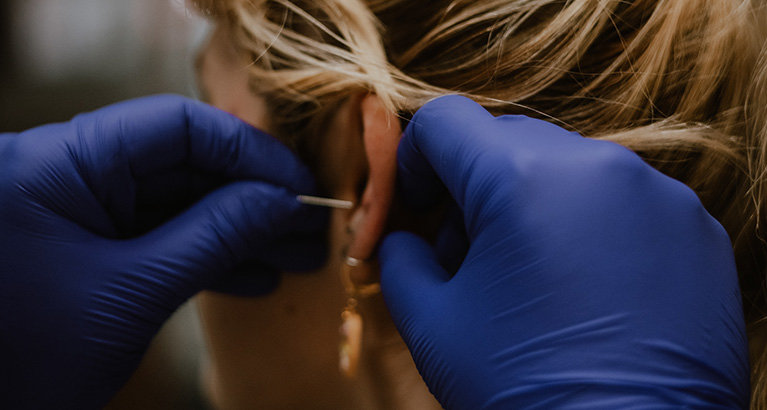
A needle leaves a clean channel with room to heal. A gun forces a blunt stud through by pressure, which cartilage does not tolerate well. Our needles are single use, sterile, and opened in front of you.
Every fresh ear piercing is fitted with nickel-free, implant-grade titanium and a flat back, so there is no butterfly clutch catching your hair or pressing into your pillow.
Not every ear has the fold for a daith, rook, or industrial. If yours does not, we will show you in the mirror instead of piercing something that will migrate out. Our guide on why anatomy matters for piercings explains more.


Not sure what your placement is called? Bring a photo. Once your piercing has fully healed, you can swap in something new from our online body jewelry store, where you can shop by piercing type.
The soft lower part of the ear and the best place to start. We do single, double, and stacked lobe piercings. Lobes heal the fastest of any ear piercing and take almost any style of jewelry once settled, from studs to hoops.
The outer rim of the upper ear and the most requested cartilage piercing. We also do forward helix (the small ridge at the front where the ear meets your head) and double or triple helix. Once healed, a helix suits studs, clickers, and fitted hoops. Wondering how it differs from other cartilage placements? Read cartilage vs. helix piercings.
The small flap of cartilage in front of the ear canal. A tragus sits close to earbuds and phone calls, so a flat-back stud is the usual choice while it heals. Small studs and snug hoops work well once healed.
The small ridge above the lobe, opposite the tragus. It is anatomy-dependent, and healing commonly takes 6 to 12 months. See our full guide to anti-tragus piercings to find out if your ear suits one.
The large bowl in the middle of the ear, done as an inner or outer conch. It is one of the few placements that can wear a larger hoop well once fully healed.
The small fold of cartilage just above the ear canal. It needs a defined fold to sit in, so your piercer will check your anatomy first. Once healed, a daith is usually worn with a curved hoop or clicker.
The ridge of cartilage in the upper inner ear, above the daith. Like the daith, it depends on your ear having the fold. Curved barbells are the most common rook jewelry.
Two piercings through the upper ear joined by one straight bar. It needs a particular ear shape to sit correctly, so we assess your ear before booking it in. Custom bars and decorative industrial pieces are available once it has healed.
Had an ear piercing close up? Our guide on re-opening vs. re-piercing explains your options.
Good aftercare is simple. Most problems come from doing too much, not too little.
We recommend NeilMed saline spray for cleaning and Cetaphil's gentle cleanser for daily care. Read why in our post on NeilMed and Cetaphil piercing aftercare, and check the piercing aftercare products you should avoid.
Healing slower than expected? You might be making one of these body piercing healing mistakes.
Most people describe it as a quick, sharp pinch that lasts a second or two, followed by a dull ache. Lobes are the least painful. Cartilage piercings like the helix, conch, and industrial are firmer and usually feel a bit more intense, but the piercing itself is over very quickly.
Lobes usually settle in 6 to 8 weeks, though full healing can take up to 3 months. Cartilage piercings commonly take 6 to 12 months. Healing depends on the placement, your aftercare, and how much the piercing gets bumped or slept on.
Avoid pools, hot tubs, lakes, and the ocean until your piercing is fully healed. Water can carry bacteria into a fresh piercing. Showers are fine. Rinse the area with clean water afterward.
A lobe piercing is the best place to start. It is the least painful, heals the fastest, and works with almost any jewelry. If you want your first cartilage piercing, the helix is a popular next step.
Have more questions? See the full piercing FAQ or contact your local studio.
Walk in at any of our six Ontario studios:
Looking for something else? Explore our body piercing and facial and oral piercing services, or see all piercings.
Already healed? Browse ear jewelry online.