Small Tattoos: What Works and What Does Not

Small tattoos are the most requested work in the trade. They are also the ones most often regretted, and not because people change their minds about the subject. They are regretted because a piece that looked perfect at the appointment did not stay looking that way.
That is a solvable problem, and it is solved before the needle rather than after.
The One Thing That Decides Everything
Ink moves. Not much, and not quickly, but every tattoo spreads slightly into the surrounding skin over years. It is what tattooed skin does, and it happens to everybody.
On a large piece, a fraction of a millimetre of spread is invisible. There is space between the lines and the drawing has room to absorb it.
On a small piece, that same fraction is the gap between two lines. Fine detail closes up. Letters fill in. A tiny gap that gave a design its shape disappears, and what was a delicate drawing becomes a mark.
So the question with any small tattoo is not whether it looks good today. It is whether the design still reads once everything in it has thickened slightly. That is the judgement you are paying an artist for, and a good one will tell you plainly when a design is being asked to work at a size it cannot hold.
What Holds Up Small
Bold simple shapes. A design with few lines, generous space between them, and a silhouette you could recognize from across a room.
Solid black. Black is the most stable pigment there is and a filled shape has nothing fine to lose.
Negative space used deliberately, where the gaps are large enough to still be gaps in fifteen years.
Single subjects. One clear thing, drawn confidently.
Line weight that varies. An artist who thickens some lines and keeps others fine builds in a design that still has contrast after everything has softened a little.
What Does Not
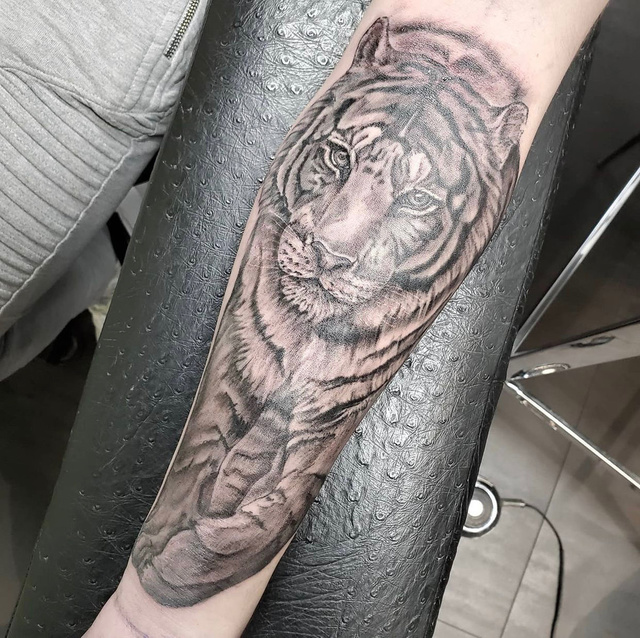
Portraits. A face is made of subtle tonal shifts, and small tonal shifts merge. Portraits need size and there is no way around it.
Dense fine detail. Feather barbs, individual leaves, watch mechanisms, fur texture. Whatever the detail is, if the lines are closer together than roughly a millimetre, plan for them to become one line.
Tiny lettering. Script below about a centimetre in height is fighting physics. It can be done, it looks lovely at first, and it is the single most common thing we are asked to fix.
Fine gaps inside patterns. Mandalas, geometric work and dotwork all depend on their negative space, and at small scale that space is the first thing to close.
Heavy colour packing in a small area. Colour needs room to sit and to be shaded, and lighter pigments are less stable than black to begin with.
Fine Line, Honestly
Fine line work is the dominant style in small tattoos right now, and it deserves a straight answer rather than either the marketing version or the snobbery.
It is real work, it takes genuine skill, and it looks beautiful. It also uses the thinnest lines in the trade, which means it has the least margin for the spreading described above. A fine line piece will soften more visibly than a bold one over the same period.
That is not a reason to avoid it. It is a reason to plan for it. Fine line ages best when the design is simple, when the lines are not crowded together, and when it is somewhere that does not get constant sun or friction. It ages worst as tiny script on a finger.
Our article comparing fine line and bold traditional goes through both in detail and is worth reading before you decide.
Placement, which matters more than the design.
Where a small tattoo goes affects how long it looks like itself more than almost any design choice.
The worst places for small work. Fingers, hands, feet and the outer edges of wrists. The skin there regenerates faster, it takes constant friction, and it holds ink poorly. Finger tattoos frequently need touching up within a year and some never hold cleanly at all. Any artist who tells you this before you book is doing you a favour.
The best places. Inner forearm, inner upper arm, the back of the shoulder, the ribs, the thigh, the ankle above the bone. Skin that is stable, not constantly rubbed, and mostly covered.
Sun is the other half of it. Ultraviolet light breaks pigment down, and a small piece has less ink to lose. A tattoo on a forearm that is outside all summer will fade faster than the same piece on a thigh. Our article on what damages a healed tattoo covers it properly.
Bend points. Anywhere that folds constantly, like the inside of an elbow or the front of an ankle, works skin harder and softens lines faster.
The Price Question
Small does not mean cheap, and the reason surprises people.
A tattoo of any size involves setting up a sterile station, opening single use needles and tubes, drawing or adjusting the design, and the artist's time. Most of that cost is identical whether the piece takes twenty minutes or three hours. That is why studios have a minimum, and it is not a markup.
There is a better way to think about it. A small piece placed and drawn properly by somebody who told you honestly what would work is a good use of a studio minimum. The same money spent twice, once on the original and once on a cover-up, is not. Our article on what a tattoo costs in Ontario explains why nobody can quote you over the phone.
Getting Several Small Pieces
A lot of people build a collection of small tattoos over years rather than committing to one large piece, and it works well when it is thought about.
Leave space. Pieces placed too close together stop reading as separate things once each has softened slightly, and what was three small tattoos becomes one crowded patch.
Keep the weight consistent. A collection of pieces done in similar line weights reads as intentional. A mix of very fine and very bold pieces on one forearm reads as a series of unrelated decisions.
Think about the direction they face and how they sit when your arm is by your side, which is how other people mostly see them.
And if you think you may eventually want a larger piece in that area, say so early. Scattered small tattoos are one of the harder things to design around later.
Aftercare
Small does not mean less care. It means the same care on a smaller area, and it matters more rather than less, because a small piece healing badly loses proportionally more of itself.
Keep it clean, keep it moisturized with a thin layer rather than a thick one, keep it out of the sun, and do not pick anything. Our article on how a tattoo heals week by week is the full version.
The one thing worth adding for small work is patience about judging it. A small piece looks its worst around days four to seven, when it is flaking and the lines look thick and blurry. That is not what it will look like. Wait a month before deciding anything.
Touch-Ups
Small tattoos are more likely to need a touch-up than large ones, particularly in the awkward placements, and that is normal rather than a sign anything went wrong.
Our touch-ups are free within the first year on our own work, done by the artist who did the piece. See our article on tattoo touch-ups for what to expect and when to come back.
Script, Dates and Initials
The most requested small tattoo of all, and the one with the most physics working against it.
Letters are made of thin strokes separated by small gaps, and those gaps are exactly what closes up as a tattoo settles. In a word set very small, the enclosed spaces inside letters like a, e, o and g fill first. The word stays readable for years and then quietly stops being readable.
There are three things that fix it and they are all decided before the stencil goes on.
Size. Roughly a centimetre in letter height is where script starts to be comfortable. Below that you are relying on everything going perfectly.
Typeface. A script with real variation between thick and thin strokes survives far better than a uniform hairline font, because the thick parts hold the shape once the thin parts soften. Anything with very tight loops is a poor choice small.
Length. A single word or a short date works. A sentence at the same letter height becomes a long piece, and a sentence shrunk to fit becomes a grey line in a decade.
Dates are the safest of the three, because numerals have simpler shapes and fewer enclosed gaps than letters do.
Does Small Hurt Less?
A little, and less than people expect.
The size of a tattoo affects how long you sit rather than how much any given moment hurts. A small piece is over quickly, which genuinely matters, but the sensation while it is happening is the same sensation.
What actually decides how much it hurts is where it is. Ribs, sternum, the top of the foot, the inside of the upper arm and anywhere close to bone are harder than the outer forearm or the thigh, whatever size the piece is. Our article on how much tattoos hurt by placement goes through it honestly.
The one thing worth knowing is that people booking something small often brace for a long ordeal and are surprised by how quickly it is done. Twenty minutes is a common answer.
Covering a Small Tattoo Later
Worth understanding before rather than after, because it is counterintuitive.
A small tattoo is not easy to hide. Covering any tattoo means putting more ink over existing ink, and the new design has to be darker and bigger than the old one. So a small piece is usually covered by something considerably larger, not by something the same size.
That is not a reason for anxiety about getting one. It is a reason to place a small piece somewhere you would be happy to have a larger piece one day, and it is another argument for spending the consultation time getting the design right rather than shrinking something that was never meant to be small.
Bringing a reference from the internet
Almost everybody arrives with a saved image, and that is genuinely useful. It is worth knowing what an artist is doing when they look at it.
Photographs of tattoos online are taken minutes after the piece is finished, in good light, usually close up and often edited. What you are looking at is a tattoo at its absolute best, before it has healed, settled or aged a day. That is not deception, it is simply how the trade photographs its work, and it is why an artist will sometimes look at a reference and suggest changes rather than copying it.
The other thing worth knowing is that a lot of the images circulating are digital illustrations rather than photographs of real tattoos, and those are drawn without any of the constraints skin imposes.
Bring the reference anyway. It tells us what you like far faster than words do. Just expect a conversation about what will hold at your size and in your placement, rather than a promise to reproduce the picture exactly.
At Perfect Image
Our artists will tell you honestly whether a design works at the size you want. Sometimes that means suggesting it goes slightly larger, sometimes it means simplifying the drawing, and occasionally it means saying that a particular piece will not hold at any small size.
That conversation is free and it takes twenty minutes. It is also the difference between a piece you still like in ten years and one you are asking somebody to cover.
Bring your reference image, tell us roughly where it is going, and we will show you what will happen to it over time.
Bottom Line
Small tattoos work when the design is simple, the lines are not crowded, and the placement is somewhere stable and out of the sun. They fail when a drawing built for a page is shrunk to a coin. Ask your artist what this specific design will look like in ten years, and take the answer seriously.
FAQ
What size is too small for a tattoo?
It depends entirely on the design rather than on a number. A solid shape works tiny. A design with lines closer together than roughly a millimetre will close up.
Do small tattoos fade faster?
They do not fade faster, but they show it sooner, because there is less ink and less space to absorb the spread.
Do finger tattoos last?
Often not well. The skin regenerates quickly, takes constant friction and holds ink poorly. Expect touch-ups and accept that some never hold cleanly.
Why do small tattoos cost so much?
Because most of what you are paying for is setup, sterile single-use equipment, design time and the artist's time, and those barely change with size. That is why studios have a minimum.
Can I get a small portrait?
Realistically no. Faces are built from subtle tonal shifts, and those merge at small scale.
Is fine line a bad idea?
No. It is beautiful work, and it needs planning. Keep the design simple, keep the lines apart, avoid high-friction placements, and keep it out of the sun.
Where is the best place for a first small tattoo?
Inner forearm, inner upper arm, back of the shoulder or thigh. Stable skin, mostly covered, easy to look after.
How long before I know what it really looks like?
About a month. It looks its worst around day four to seven, and that is not the finished piece.